Company values and growth: Goethe's Faust and the deal whose price arrives later
The contract looks reasonable, the goal is noble, and two old people with their linden trees are simply in the way. Goethe on growing companies and decisions taken "just this once"
Company values and growth rarely collide in the open. Nobody at the meeting proposes selling the principles. Someone proposes closing the quarter, keeping the big client, or putting up with the top salesman until year-end. Goethe spent two parts of a tragedy on this mechanism. In Faust the contract is reasonable and the hero's goal is noble, and he learns the price when it can no longer be changed.
- The conflict between values and growth starts with sensible exceptions. Each one can be justified, and each one moves the line a little further.
- A company's real values show at the moment they cost money, a client or a strong employee. Everything else is wall decoration.
- Companies have a shadow: what gets done for results and stays out of the official image. The person at the top often sincerely does not know how a problem was "taken care of".
- Owners, boards and HR should agree in advance what the company will not do even for growth, and test that on expensive decisions.
The story, briefly
Faust, a scholar, has mastered every science and despairs, because none of it has given him a life. Mephistopheles enters his study first as a black poodle that followed him home from a walk, then offers his services. Faust sets the terms as a wager: if he ever says to a moment "Stay, you are so lovely!", the devil may have him. They sign in blood.
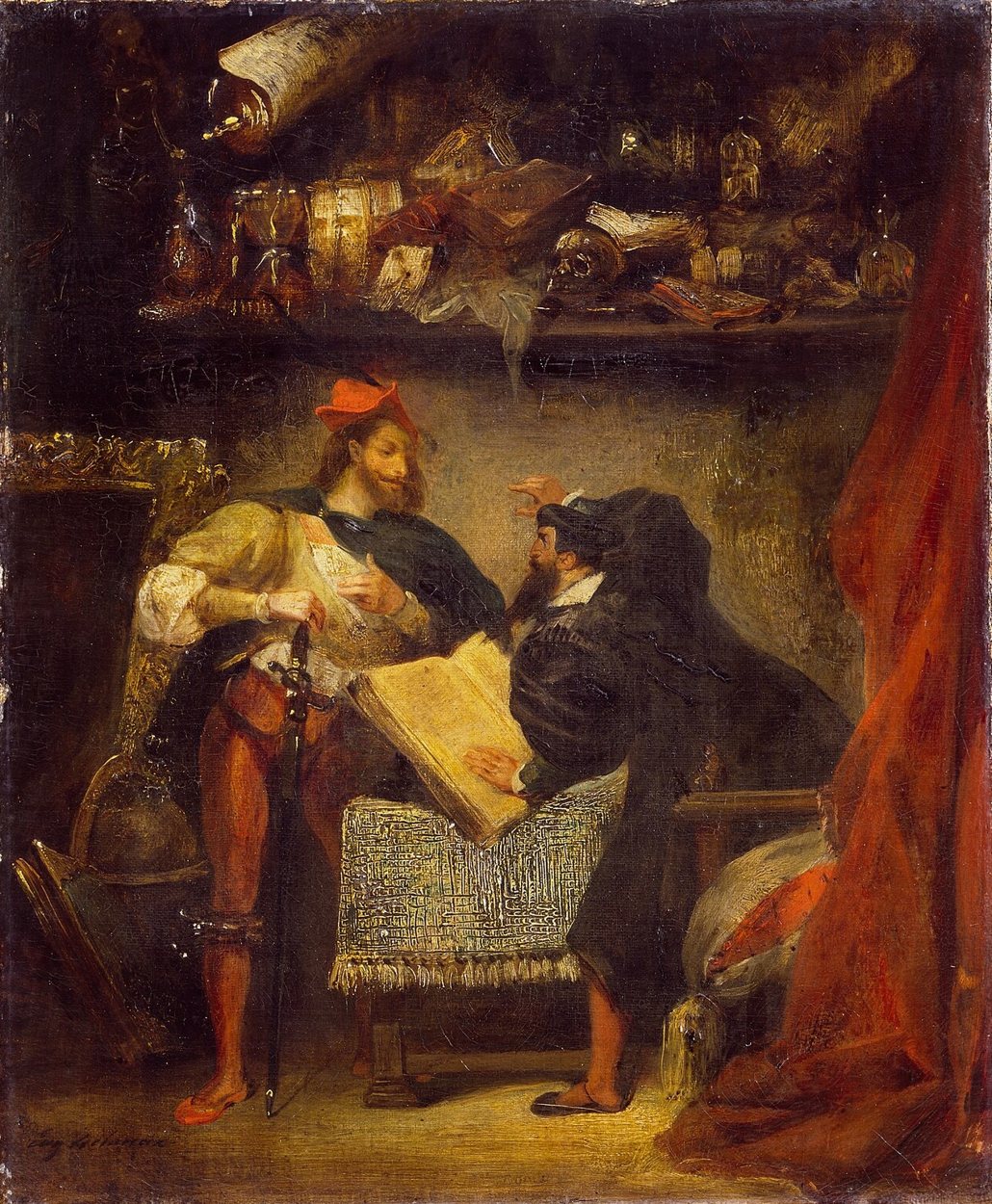
Part One ends in catastrophe for Gretchen, the girl Faust loved. Her mother dies from a sleeping draught he supplied, he kills her brother in a duel, and she ends up in a dungeon awaiting execution. The emperor grants Faust a strip of coast, and he reclaims land from the sea with dykes and canals, to make room for millions of people.
Why company values and growth pull apart
Edgar Schein described three layers of organisational culture: what can be seen from outside, espoused values, and the basic assumptions people act on without thinking. Espoused values are easy to write down. Basic assumptions show under pressure, when the target is being missed and the investor is waiting for a number.
Patrick Lencioni opened his 2002 Harvard Business Review article with one company's list of values: communication, respect, integrity, excellence. The company was Enron. He also reported that 55% of the Fortune 100 named integrity as a core value, and wrote a sentence every owner should keep in mind: when properly practised, values inflict pain. They rule out some opportunities, some clients and some people.
That makes growth the real test. In a small company, values live on the founder's personal example and cost almost nothing. As the stakes rise, each value acquires a price, and you find out which ones were real.
What the bargain looks like
Nobody uses blood. Goethe's devil comes as a poodle, and in companies the contract looks just as harmless:
- The star exception. The best salesman humiliates colleagues and brings in a third of revenue. Everyone knows, and his contract gets renewed.
- The client you cannot lose. You promise what you will not deliver, and the team learns that this is normal.
- The metric that replaces the purpose. A narrow target gets set, and people start working for the number.
- Hiring for speed. You need a hundred people by spring, and interviewers stop asking what used to be non-negotiable.
Research shows how quietly this happens. Francesca Gino and Max Bazerman found in experiments that people accept misconduct far more readily when it grows gradually than when the same act comes all at once. Lisa Ordóñez and colleagues, in "Goals Gone Wild" (2009), described the side effects of hard targets: narrowed attention, lower intrinsic motivation and a readiness to cut corners.
Goethe has a scene for this as well. Mephistopheles offers a bankrupt empire paper money, secured by treasure still buried in the ground. The emperor calls it a fraud and asks who forged his signature, and is told that he signed it himself, the night before, at a masked ball, dressed as Pan. He gives in. Plenty of owners know that morning-after conversation about a decision taken in general excitement, on promises secured by the future.
Mephistopheles as the company's shadow
In Psychological Types Jung argues that Faust raises the problem to a height from which Faust and Mephistopheles turn out to be one and the same person. Mephistopheles is all the life that did not fit inside the scholar, including power. Analytical psychology calls this part the shadow: something a person refuses to recognise in themselves, which therefore acts without them.
Organisations have one too. The more spotless the image on the website, the more awkward work falls to people the website does not mention. Faust has Mephistopheles and three strongmen for this. They sail out with two ships and return with twenty, and Mephistopheles explains that war, trade and piracy are a trinity you cannot separate. Faust watches the fleet from his balcony and talks about something else.
In a company this is the person who "knows how to get things done", or the division nobody questions while the numbers hold. It suits the person at the top not to know the details. It suits the people around them even better.
Philemon and Baucis: the cost that was not in the budget
One patch of the reclaimed land does not belong to Faust: the hut of an old couple, a chapel and some linden trees. For him this poisons the whole estate: the smallest tree in someone else's field, he says, detracts from everything he owns. The couple have already been offered a good plot elsewhere. Faust tells Mephistopheles to move them.
That night Mephistopheles and the strongmen go to the hut. It burns, the old people die of terror, and their guest dies in the fight. When Faust hears, he says: "I wanted exchange, not robbery." He means it. He also gave the order, knowing whom he was sending.
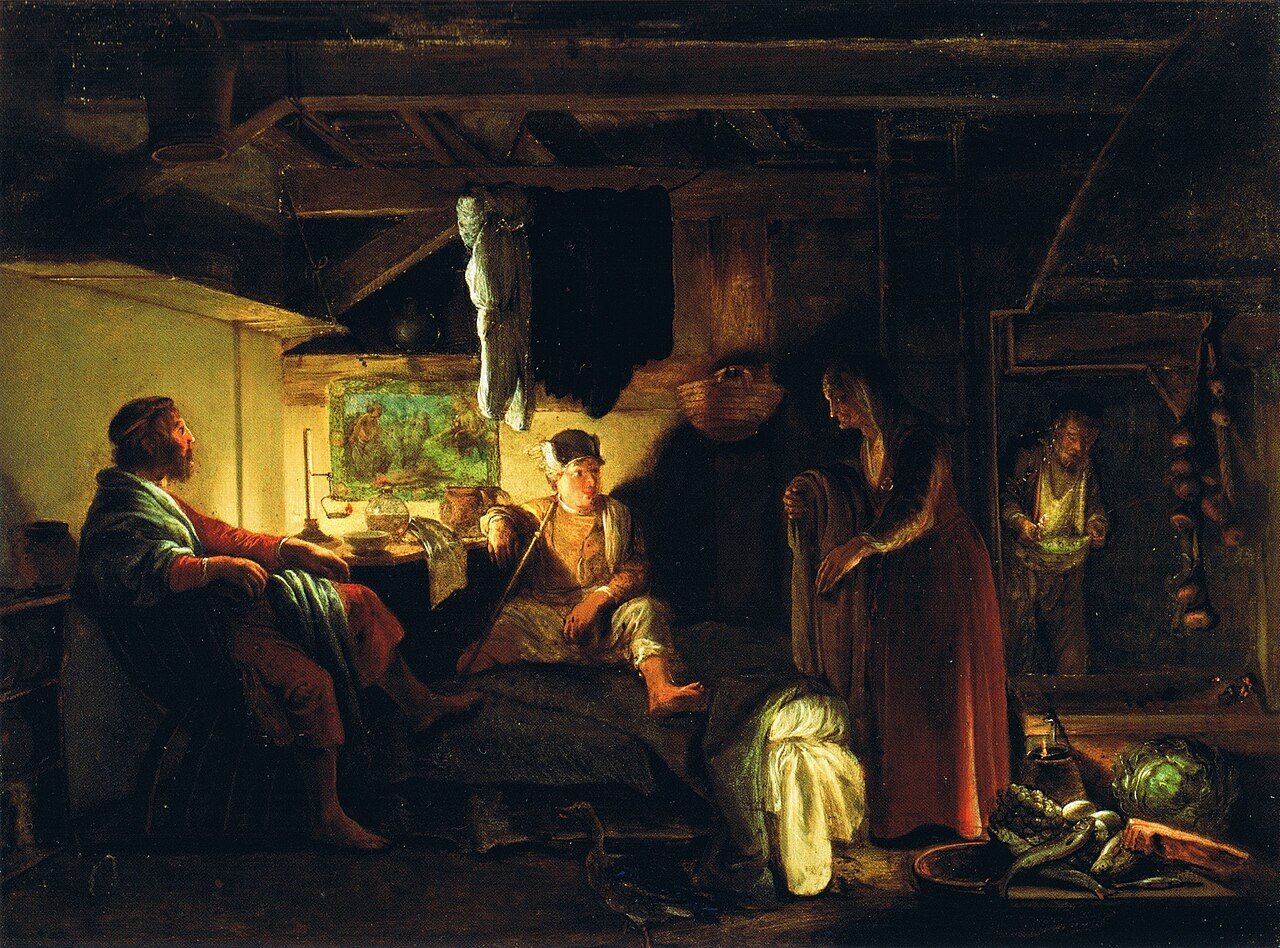
For a leader, this is the most accurate moment in the play. People at the top rarely order anything bad. They say "take care of it", "I don't want this here by the end of the quarter", "I don't care how". Somebody takes care of it. And then the person at the top is outraged, also sincerely.
In a company, Philemon and Baucis are usually whatever spoils the picture: the veterans who were there at the start, a small product, the first clients, the department that asks awkward questions. They take up little room and seem to cost nothing, until someone counts what happened to everyone else's trust after watching how they were treated.
The one you cannot keep out
After the fire, four grey women come to the palace: Want, Debt, Need and Care. (The German word Schuld means both debt and guilt.) Three of them cannot enter a rich man's house. The fourth slips in through the keyhole. Care asks Faust whether he has ever known her, then breathes on his eyes, and he goes blind.
Next he hears the clatter of spades and rejoices: the works are moving, the sea is retreating. In fact the lemures are digging his grave, and Mephistopheles jokes about it under his breath. It is to this sound that Faust finally speaks the fatal words about the moment.
Anyone running a large company knows this. The dashboards are green, there is a sound of work all around, and it gets harder and harder to see what is actually being dug. Bad news stops reaching the top, and the people around the leader are only part of the reason. More on that in the article on psychological safety in teams.
Signs that values are being traded for growth
- "just this once" gets said every quarter;
- people are promoted for numbers, and everyone knows how the numbers were reached;
- asking "how did we get this?" is treated as nit-picking;
- strong people leave without giving the real reason;
- the founder keeps learning about the company's decisions after the fact, with surprise.
What owners, boards and HR can do
- Name the price in advance. Agree what the company will not do even to hit plan, and how much it is prepared to lose for that. This conversation can only be calm before the crisis.
- Test values on expensive decisions. Review one or two cases a year at board level where a value cost money: what you did, what you lost, what it taught people.
- Ask how the result was reached. Put that question next to "how much" in every results review.
- Look at who the company tolerates. One contract renewal for a toxic star says more about the culture than any values document.
- Retire "I don't care how". If a task smells bad, the person at the top should know how it will be handled.
- Ask about Philemon. Before a big move, discuss who and what will be in the way, and how they will be treated.
- Bring in an outside view. A business psychologist or consultant sits outside the hierarchy and can show where the stated and the real diverge, and what part the leader plays in that.
Goethe does not condemn growth. In the prologue the Lord says that man errs for as long as he strives, and at the end the angels carry Faust away because he strove to the last. The dyke stands and the land is won. It stands where the linden trees used to be, and Faust can no longer go out to look.
Frequently asked questions
How are company values and growth connected?
Growth stress-tests values. In a small company they rest on the founder's personal example and cost almost nothing. As the company grows, each value acquires a price in money, clients or people, and it becomes clear which values are real and which are only stated.
How can you tell a company is sacrificing its values for growth?
Typical signs: exceptions repeat every quarter, people are promoted for numbers regardless of how they were reached, asking how a result was achieved is seen as nit-picking, strong people leave without explanation, and the founder learns about decisions after the fact.
How do you test whether a company's values are real?
Look at decisions where a value cost money, a client or a strong employee. Patrick Lencioni wrote that real values inflict pain: they limit strategy and exclude some people. If nobody can recall such a case, the values probably exist only on paper.
Why use Goethe's Faust to talk about business?
The play describes the mechanism precisely: the contract looks reasonable, the goal is noble, others do the unpleasant work, and the person at the top is sincerely outraged by the outcome. The Philemon and Baucis episode shows the cost that was never in the budget, and Faust's blindness shows how a leader stops seeing what is actually going on.
How can a business psychologist help?
An outside specialist is not part of the company hierarchy, so people often speak more openly. They can help identify where stated values diverge from real decisions, explore the leader's own part in that, and prepare conversations that do not work inside the company.